AI in PR: Who's Accountable When AI Writes the First Draft?
By Mohammed Elbatta, Founder & Managing Director, Fekra Communications · 17 November 2026 · 6 min read
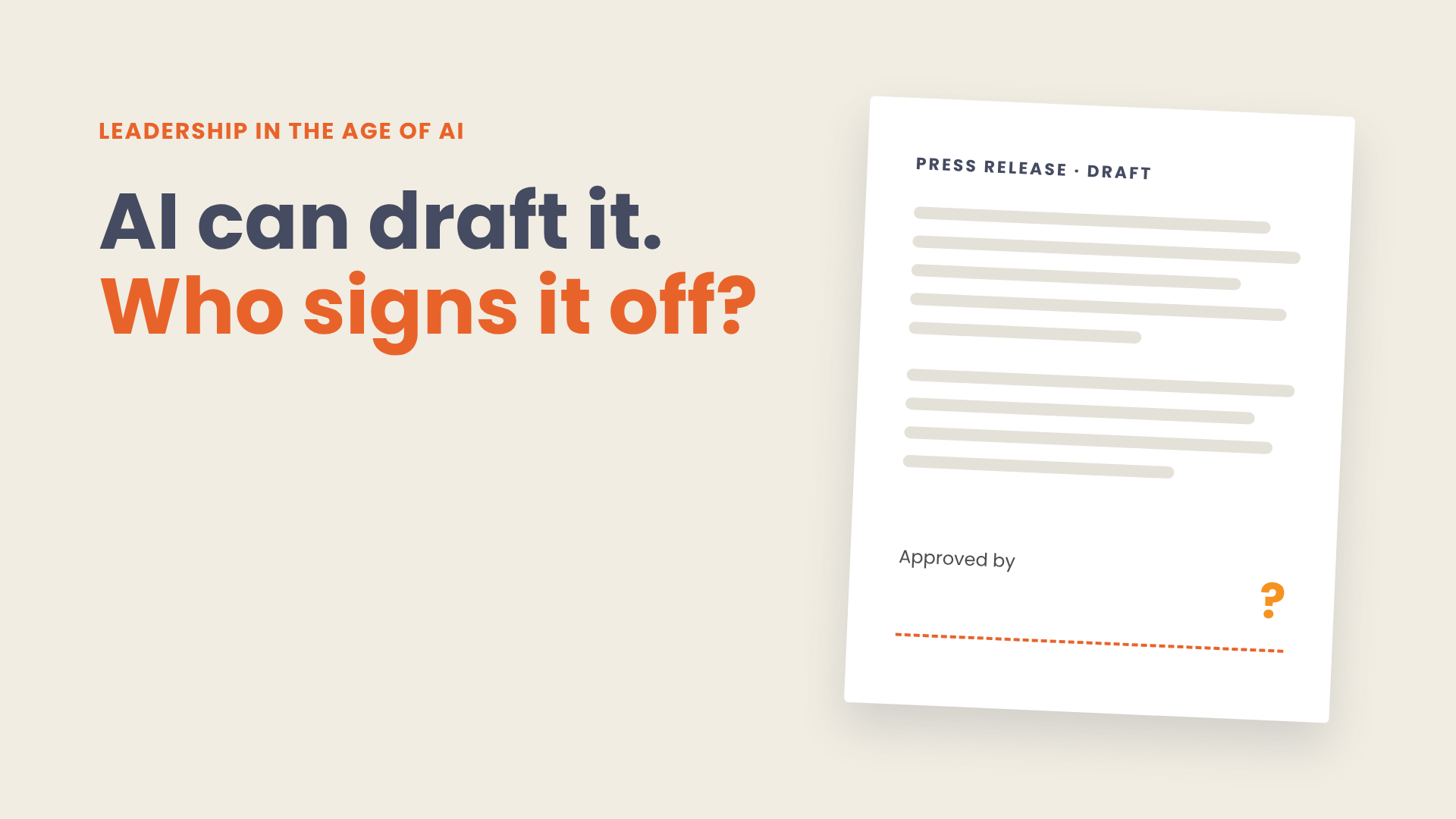
AI is already in the PR workflow. The process around it hasn't caught up.
I've been in communications for thirty years, and I've seen plenty of tools arrive with big promises. Most of them made us faster and changed little else. AI in PR feels different to me, and the speed isn't the reason. It's changing who answers for the words that go out.
By now most PR teams, agency and in-house, use AI in some form, mainly to draft, summarize and brainstorm. What's still rare is a team that has rethought the rest of the job around it. The draft arrives in seconds, then goes through the same reviews and approvals as before. That's where communications leaders need to start paying attention.
Who is accountable when AI writes a press release?
In our work, mistakes happen in public. A statement, a social post or a briefing note can't be quietly fixed once it's out, and one wrong sentence travels further than any correction. It's no surprise that LexisNexis found people in PR and media are more worried about misinformation than any other industry it surveyed.
AI writes confidently even when it's wrong, and that's the real risk. A holding statement that apologizes for something the client hasn't confirmed reads every bit as smoothly as the correct one.
We've seen this first-hand. On one project, an AI draft produced a set of references for a client document, with names, job titles and companies. It looked thorough. When the team checked every detail before it went out, some of those people turned out not to exist, and neither did some of the companies. The tool had simply made them up. We pulled the section, found the right references by hand and reworked the document. It cost us time, but it would have cost a lot more if the client had found it first.
Research from Accenture and the Wharton School this year makes a point I agree with: AI lets an organization do far more work, but responsibility doesn't grow with it. People have to stay in charge and own the outcome.
For a communications team, that means three practical things. Every piece of AI-assisted work has one named person who signs it off after checking the facts, the tone and the context. Factual claims are traced back to a source. And clients know from the start how AI will be used on their account.
Where should the time AI saves actually go?
If AI takes two hours of drafting off a consultant's desk, those two hours need a destination. Otherwise they disappear into more internal review.
The best use of that time is the work machines still do poorly. Building relationships with journalists. Preparing a CEO before a tough interview or a difficult announcement. Turning monitoring data into advice a client can act on. That's the core of good PR and strategic communications, and it's where clients feel the difference.
Why this matters even more in the UAE and MENA
Communications in this region carries layers a general AI tool won't reliably pick up. Much of the work runs in Arabic and English. Media cultures differ from one market to the next. Religious calendars and national occasions shape what can be said, and when. A message that lands well in Dubai can need real rework for Riyadh or Cairo, and that judgment has to come from someone who knows the market.
The same applies to content creation and social media. AI can produce volume, but the nuance that makes content work in this region still needs a person who understands the audience.
What skills do PR teams need in the age of AI?
KPMG found this year that 57% of leaders now expect their people to manage and direct AI agents, not just use them. The same research found leaders rate adaptability and continuous learning above technical skills for entry-level roles, by 83% to 67%.
For communications teams, the skills that matter more every year are editorial judgment, the habit of checking every claim, a clear sense of what should never be automated, and comfort working across cultures and languages.
There's also a training question our industry hasn't answered. Most of us learned by writing a weak first draft and having someone senior take it apart. If AI writes the first draft now, juniors need another way to learn what good looks like. Otherwise we'll end up with people who can prompt well but can't tell when something is wrong.
AI search is now part of your reputation
More people now ask AI assistants about companies instead of searching for them. What those assistants say depends on what credible sources have published: earned media coverage, real thought leadership, and accurate information about the business. That's why I see generative engine optimization (GEO) as part of PR. If your brand isn't showing up in trusted sources, it won't show up in AI answers either.
Five things communications leaders can do in the next 90 days
- Find out where your team already uses AI, including the tools people use informally.
- Make a named reviewer mandatory for anything AI helped produce.
- Write down what you won't automate. Ours includes condolence messages, personal apologies from leadership, and anything touching faith or national sensitivities.
- Rebuild one process properly, such as media monitoring or press release production, before trying to change everything.
- Tell your clients how you use AI. They'll ask, and it's better they hear it from you first.
Frequently asked questions
AI is taking over parts of the job, mostly drafting, summarizing and monitoring. The parts clients value most, such as judgment, relationships and accountability, still need people and are becoming more important.
Yes. Being open about it builds trust and lets both sides agree on review, accuracy and confidentiality before the work starts.
It speeds up monitoring and first drafts, which helps when time is short. But a crisis statement still needs a senior person who owns every word. Speed only helps if the message is right.
GEO is the work of making sure a brand is described accurately when people ask AI assistants about it. It relies on strong earned media, credible content and consistent information, which is why it sits naturally within PR.
Thinking about how AI fits into your communications?
We help brands across the UAE and MENA use AI where it makes sense, while keeping the judgment, relationships and accountability that protect their reputation.
About Mohammed Elbatta
Mohammed Elbatta is the founder and managing director of Fekra Communications, a PR and communications agency in Dubai. He has 30 years of experience in communications, including senior roles at FleishmanHillard, APCO Worldwide and Meraas. He is a member of the Chartered Institute of Public Relations (UK) and MEPRA, and has served on the PRCA MENA board.